
What is RAG? Retrieval-Augmented Generation Explained
Citai Team
March 6, 2026 · 10 min read
What is RAG?
Retrieval-Augmented Generation (RAG) is an AI architecture that combines two capabilities: searching for relevant information in a knowledge base and generating natural responses using a language model (LLM).
Unlike a traditional chatbot that “makes up” answers based on training, a RAG system cites real sources from your documents.
Why does it matter?
LLMs like GPT-4 or Llama have a known problem: they hallucinate. They generate convincing but fabricated text. RAG solves this by forcing the model to base answers on real documents.
Citai’s RAG Pipeline
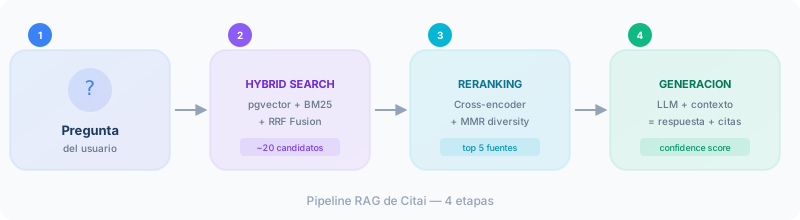
Stage 1: Hybrid Search
The system searches for the most relevant fragments using two simultaneous methods:
- Semantic search (pgvector): Understands meaning. “How do I cancel my plan?” finds “subscription cancellation process”
- Keyword search (BM25): Finds exact matches. “ERR_429” finds it instantly
- RRF Fusion: Combines both rankings taking the best of each method
Stage 2: Reranking
A cross-encoder model reorders ~20 candidates evaluating query+document together. Slower but much more precise.
Stage 3: MMR Diversity
Maximum Marginal Relevance eliminates redundant fragments. If 3 of the top 5 say the same thing, keeps 1 and brings others with complementary information.
Stage 4: Generation with citations
The LLM receives filtered fragments as context and generates a natural response citing exact document, page, and fragment.
Who is RAG for?
RAG is ideal for any company with internal documentation that wants:
- An assistant that answers questions about products or services
- Reduce support tickets with verifiable automatic answers
- A chatbot that doesn’t make things up
Citai implements enterprise-grade RAG with a 3-stage pipeline. Try it free →
Try Citai for free
Create your intelligent knowledge base in minutes. No credit card required.
Create free accountRelated articles
Embeddings and Semantic Search: How Context-Aware AI Works
Understand how embeddings transform text into vectors to find information by meaning, not exact words.
Read article → Practical GuideHybrid Search: How to Balance Semantic and Keyword Search in RAG
Learn to adjust the weight between vector search and BM25 to maximize relevance based on your content type.
Read article → TechnologyContextual Retrieval: What It Is and Why It Improves RAG
How enriching each chunk with document-level context before indexing transforms search quality in RAG systems.
Read article →