
AI Chatbot vs Traditional Chatbot: Why Sources Matter
Citai Team
March 6, 2026 · 12 min read
The problem with traditional chatbots
Traditional chatbots work with rules and decision trees. If user says X, respond Y. Clear limitations:
- Rigidity: Only understand exact programmed phrases
- Costly maintenance: Each new question = new rule
- No context: Don’t understand variations or synonyms
The third way: RAG with citation
| Feature | Traditional | LLM Only | RAG (Citai) |
|---|---|---|---|
| Natural responses | No | Yes | Yes |
| Based on your docs | No | No | Yes |
| Cites sources | No | No | Yes |
| Detects “I don’t know” | No | No | Yes |
| Updates | Manual | Retrain | Upload doc |
Why do sources matter?
When an assistant cites the exact source (document, page, fragment), users can:
- Verify the answer in seconds
- Trust the information
- Dive deeper reading the full document
Confidence scoring
Citai measures how certain each response is:
- High confidence: Answer based on highly relevant fragments
- Low confidence: Warns information may not be accurate
- No information: Honestly says “I don’t have enough information”
Decision framework: when to use each type
Not every scenario needs AI. Here is a practical guide:
Use a traditional chatbot when:
- 100% predictable flows: Bookings with fixed options, surveys with closed answers
- Strict regulations: Industries where every response must be legally approved word by word
- Low volume: Fewer than 50 unique questions total — the ROI of setting up RAG does not justify the effort
- No existing documentation: If there are no documents, RAG has nothing to draw from
Use RAG with AI when:
- Large knowledge base: Manuals, policies, technical docs, extensive FAQs
- Unpredictable questions: Users phrase the same questions in very different ways
- Frequent updates: Content changes and you do not want to reprogram rules
- Multiple languages: Multilingual RAG understands intent without per-language rules
Use a hybrid approach when:
- Critical flows + open questions: For example, a banking bot that uses rules for transfers but RAG for product inquiries
- Gradual migration: Start with rules and progressively add RAG capabilities
The hybrid approach: best of both worlds
In practice, most successful implementations combine both approaches:
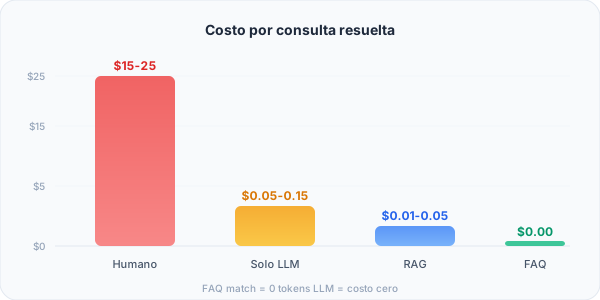
Layer 1 — Exact FAQ: Frequently asked questions with predefined answers. Cost: $0.00 per query. Latency: <50ms. Citai automatically detects FAQs via semantic similarity (configurable threshold).
Layer 2 — RAG with citation: For non-FAQ questions, the RAG pipeline searches your documents, applies reranking, and generates a response citing sources. Cost: $0.01-0.05. Latency: 2-4s.
Layer 3 — Human escalation: If confidence is low or the user requests it, the conversation escalates to a human agent with full conversation context.
Migration path: from traditional chatbot to AI
If you already have a rule-based chatbot, here is the recommended path:
Phase 1: Audit (1-2 weeks)
- Export all rules/intents from your current chatbot
- Identify questions that fail or where users drop off
- Document the most frequent responses — these will become your first FAQs
Phase 2: Parallel pilot (2-4 weeks)
- Upload your existing documentation as a knowledge base
- Import your existing FAQs
- Run both systems in parallel: the traditional chatbot visible to users, RAG in shadow mode
- Compare responses: does RAG answer better where the traditional bot fails?
Phase 3: Gradual migration (4-8 weeks)
- Redirect categories where RAG outperforms the traditional bot first
- Keep rules for transactional flows (payments, bookings)
- Monitor satisfaction metrics and escalation rates
Phase 4: Continuous optimization
- Review knowledge gaps (unanswered questions)
- Auto-generate FAQs from frequent queries
- Fine-tune RAG parameters in the Playground
Real metrics: quantitative comparison
| Metric | Traditional bot | LLM Only | RAG (Citai) |
|---|---|---|---|
| Resolution rate | 40-60% | 70-80% | 85-95% |
| Cost per query | $0.00 | $0.05-0.15 | $0.01-0.05 |
| Response time | <100ms | 3-8s | 1-4s |
| Accuracy | High (limited) | Medium (hallucinates) | High (cited) |
| Maintenance cost | High (manual rules) | Low | Low |
| Question coverage | 20-40% | ~100% | ~100% |
| Verifiability | N/A | None | Full (sources) |
Industry-specific recommendations
E-commerce
- Priority: RAG for product catalog, return policies, order tracking
- Rules for: Checkout flows, order status (direct API)
- Tip: Enable FAQ matching for the top 20 questions — covers 60% of volume at zero cost
SaaS / Technology
- Priority: RAG for technical documentation, integration guides, troubleshooting
- Rules for: Password reset, subscription management
- Tip: The Playground is your best ally — adjust chunking parameters based on your documentation length
Healthcare
- Priority: RAG for general information, procedures, schedules
- Rules for: Appointment scheduling, emergencies (immediate escalation)
- Tip: Use content rules to block queries that require medical diagnosis
Education
- Priority: RAG for study material, regulations, administrative procedures
- Rules for: Enrollment, payments
- Tip: Create separate KBs per department and use Smart Routing
Banking / Finance
- Priority: Mandatory hybrid approach — RAG for products and FAQ, rules for transactions
- Rules for: Transfers, balance inquiries, card blocking
- Tip: High confidence scoring (>0.85) + automatic escalation for sensitive financial queries
Ready for a chatbot that cites sources? Try Citai free →
Try Citai for free
Create your intelligent knowledge base in minutes. No credit card required.
Create free accountRelated articles
What is RAG? Retrieval-Augmented Generation Explained
Discover how RAG combines intelligent search with generative AI to deliver accurate answers with verifiable sources.
Read article → ProductHow Much Does an AI Chatbot Really Cost: Complete Breakdown
Real cost breakdown of an AI chatbot: LLM tokens, embeddings, hosting, and how Citai optimizes each component.
Read article → ProductEmbeddable Chat Widget: From Zero to Production in 5 Minutes
Install an AI assistant on your website with one line of code. Shadow DOM, SSE streaming, themes, pre-chat forms, and smart escalation.
Read article →